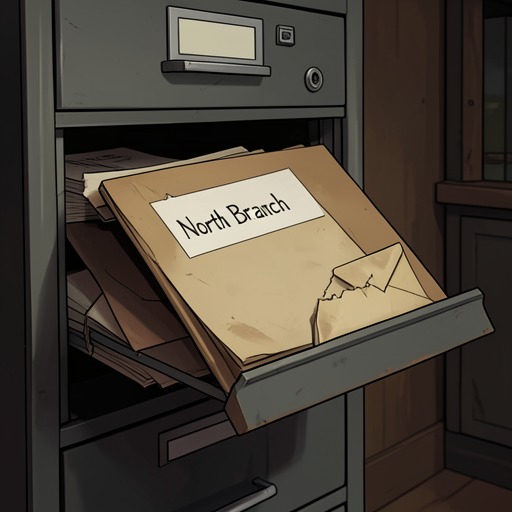
The alleged bribery at the North Branch courthouse
Presumed InnocentThe alleged bribery at the North Branch courthouse is a reported, not conclusively established, corruption case: an unsigned letter describes a $1,500 payment made to secure the dismissal of a criminal charge, while Carolyn Polhemus’s notes offer Rusty Sabich a possible route toward identifying the people involved. The account turns a seemingly routine, long-closed case into a potential scandal, yet leaves its central question—the identity of the person who took the money—unanswered.
The letter and the alleged payment
The allegation reaches Raymond Horgan in a letter from an unnamed correspondent who says the events occurred nine years earlier, during Horgan’s time as prosecuting attorney. To protect the person called Noel, the writer withholds his real name: Noel, the correspondent warns, would recognize the source and might retaliate. The writer says the charge itself was not important to the account, except that Noel was deeply embarrassed by it and feared that people around him would learn what had happened.
According to the letter, Noel’s lawyer advised him to admit the offense, on the understanding that nothing serious would happen and the matter would remain unknown. Noel instead became preoccupied with the possibility of exposure and said he intended to pay someone off. The correspondent initially doubted him, then says they supplied the money: $1,500. Wanting to see where it went, the writer accompanied Noel to the North Branch Courthouse at Runyon and 111th.
The account describes a brief, indirect handoff. A secretary who appeared to know Noel led the pair downstairs to the prosecuting attorney’s office. Horgan’s name was on the door, but the letter does not establish that Horgan was present or identify the person who accepted the money. Noel told his companion to wait outside. He was gone for less than two minutes; afterward, he showed the writer that the sock in which he had carried the cash was empty. The correspondent says Noel later described being taken to an office, told to wait at a desk, and instructed by a man behind him to leave the money in the desk’s center drawer and go without looking back.
Ten days later, when Noel appeared in court, he feared the arrangement had failed. Instead, a lawyer from the prosecuting attorney’s office told the judge that the case was dismissed. The letter writer cannot remember that lawyer’s name and says Noel would not identify the person he had paid. Thus the correspondence supplies a specific sequence—money delivered, a concealed recipient, and a prompt dismissal—but not a direct identification of either the recipient or the official responsible for the outcome.
The court and the cases surrounding it
The setting gives the claim institutional weight. Branch courts handled the first formal appearances of arrested people, bail decisions, misdemeanor trials, and preliminary evidentiary hearings in felony cases. The North Branch was not an isolated administrative backwater: it was a working court where police, prosecutors, defense lawyers, clerks, and judges processed a continuing stream of cases. The allegation nevertheless depends on private decisions made within that ordinary flow, rather than on a publicly documented payment or an identified witness inside the office.
Rusty and Dan Lipranzer consider whether Noel’s charge could have belonged to the cases arising from enforcement of the state’s Morals chapter. During Raymond Horgan’s first administration, consensual adult sexual offenses had been disregarded as a matter of policy, though police still brought cases to prosecutors. As re-election approached, the office staged a concentrated cleanup, in part after complaints about activity in the Public Forest. Dozens of men were arrested nightly, and their cases were commonly resolved through court supervision, a disposition that could later be expunged.
That campaign supplies a possible pool of cases, not proof that Noel was among those arrested. Rusty and Lipranzer estimate that about four hundred cases were brought that summer, and the letter does not give Noel’s legal name or the precise offense. The scale of the enforcement effort explains why the alias is difficult to work backward from: even if the correspondent’s account is accurate, there are many possible case files and no unambiguous name with which to begin.
Carolyn Polhemus’s trail
Carolyn Polhemus had obtained the file about five months before her murder. Its jacket shows little investigation, and the surviving notes do not establish how far she got. She repeatedly underlined Noel, then wrote Leon. Rusty interprets the second name as a possible clue: Carolyn may have treated Noel as an alias chosen through some meaningful association and supposed she should look for a person named Leon. That remains an investigative inference, not a confirmed identification of Noel.
At the foot of the notes Carolyn also wrote Kenneally and an assignment. Rusty identifies him as Lionel Kenneally, a police commander who ran the watch in the 32nd District, whose cases were heard at the North Branch. Rusty knew Kenneally through work on Night Saints cases and regards him as a good officer. The note links a named investigator to the search, but the evidence given does not say that Kenneally found Noel, confirmed the payment, or identified the recipient.
The file’s path itself troubles Rusty. He cannot see a procedural reason why he was not informed of the case, or why it went to Carolyn, who did not work in the public-corruption unit. His questions are also personal: the omission sharpens his doubts about his relationship with Raymond Horgan. The case therefore raises two connected uncertainties—what happened at the North Branch, and why the inquiry was handled as it was—without resolving either one.
Political and institutional stakes
The letter is unsigned, and Horgan’s office receives many complaints that prove worthless. This one seems credible to Rusty, although he acknowledges a basic alternative: Noel may have deceived his friend, making the correspondent’s payment part of a scam rather than a bribe. The writer, who says they witnessed the money being delivered, believes the transaction was real; that conviction is evidence about the source’s perspective, not independent confirmation of the event.
The allegation is politically dangerous even before it is verified. In an election year, Nico Delia Guardia could use evidence of concealed wrongdoing during Horgan’s administration against him. The letter’s writer also suspects the case may not have been isolated, though the document provides no separate examples. For Rusty, the possibility of a bribery ring turns the old matter into more than an individual accusation: it suggests that ordinary case processing may have hidden misconduct across a court system handling hundreds of cases.
The episode’s force lies in the gap between a vivid account and an incomplete record. The money has a stated amount and route; the court date follows ten days later; Carolyn’s notes preserve Noel, Leon, and Kenneally as investigative leads. But the alleged recipient remains unnamed, the charge remains unspecified, and the relationship between the letter and the hundreds of possible cases is unresolved. The North Branch allegation consequently remains a scandal in prospect—serious enough to unsettle Horgan’s office and reopen Carolyn’s trail, but not, on the evidence presented here, a proven account of who took the money.